


Published: September 2026 | Last Updated: September 2026
A deluxe room is a hotel room that generally offers more space, better furnishings, upgraded amenities or a better location within the property than the hotel’s standard room. However, “deluxe” is not a standardised hotel industry classification — the exact deluxe room meaning varies from one property to another, which is why the category name alone rarely tells the full story.
If you are planning a hotel stay — particularly near a high-demand destination such as Agra’s Taj Mahal — and you have seen “deluxe room” while browsing booking platforms, this guide explains exactly what the category means, what it typically includes, how it compares to standard, superior and suite rooms, and what to check before you pay the upgrade price. You can also explore the rooms at Hotel Sun Grand to see how a real Agra property presents its Deluxe, Super Deluxe and suite categories with actual specifications.
What Does Deluxe Room Mean?
In hotel terminology, understanding the deluxe room meaning helps travelers identify what they are actually getting when they upgrade from a standard room.
The critical qualifier — and the one most booking advice skips — is that hotel room categories are not standardised across the industry. One property may call a 22 m² city-view room a “deluxe room,” while another property uses the same label for a 42 m² room with a private balcony, bathtub and garden view. Both are legitimately called deluxe rooms; neither is wrong; they are simply different hotels with different internal classification systems.
This means the deluxe room meaning at any given property should be understood from that property’s own room description, listed square footage, bed configuration, bathroom specification and amenities list — not inferred from the label alone.
Key takeaway: A deluxe room is generally a step above the standard room, but “deluxe” is a property-specific label, not a certified grade.
What Does a Deluxe Room Usually Include?
Understanding the deluxe room meaning also requires looking beyond the name and checking what the hotel actually provides in terms of space, furnishings, bathroom facilities and guest amenities.
More Space
Many hotels use the deluxe category to indicate a larger floor area than the standard room. However, some properties differentiate primarily on view, floor level or room position rather than actual size. Always check the listed square footage.
Upgraded Furnishings and Bedding
Deluxe rooms often feature:
- Higher-quality mattresses, linens or pillows
- A proper seating area or sitting corner
- A dedicated work desk and ergonomic chair
- Improved in-room lighting
Better Bathroom Facilities
Bathrooms in deluxe rooms may include:
- A bathtub in addition to or instead of a basic shower
- A rain shower at select properties
- Upgraded toiletries and bathroom accessories
- Hairdryer, magnifying mirror and heated towel rail
Better Location or View
At many hotels, the deluxe category means a preferred position:
- A higher floor
- A garden view, pool view, city skyline or landmark view
- A quieter section of the property
- A balcony or terrace at some properties
Additional Amenities
Deluxe rooms may also include:
- High-speed Wi-Fi
- Flat-screen television
- Air conditioning
- Tea and coffee maker
- Mini refrigerator or minibar
- In-room safe
- Room service availability
- Robes and slippers (varies by property)
- Enhanced housekeeping frequency
Important: None of these features are guaranteed in every deluxe room. Check the specific hotel’s amenities list before booking.
How Big Is a Deluxe Room?
This is one of the questions travelers ask most often, and it is also one of the most misleading when answered with a single number.
There is no universal minimum size for a deluxe room, which is an important part of understanding the deluxe room meaning when comparing different hotels.
To illustrate the variation: Taj Hotel & Convention Centre Agra currently lists its Deluxe Room King Bed at approximately 40 sq m, while its Superior Room is approximately 35 sq m — a 5 sq m step-up within the same property. Meanwhile, a boutique hotel in the same city may list its deluxe room at 22 sq m and its standard room at 18 sq m.
These figures are real examples, not industry standards. They demonstrate why comparing room sizes across hotels by category name is unreliable. The only meaningful comparison is square footage (or square metres) on the same property’s official room page.
When evaluating room size, always:
- Check the listed m² or sq ft
- Confirm whether the measurement includes the bathroom
- Compare at least two room categories at the same property before deciding
Deluxe Room vs Standard Room: What’s the Difference?
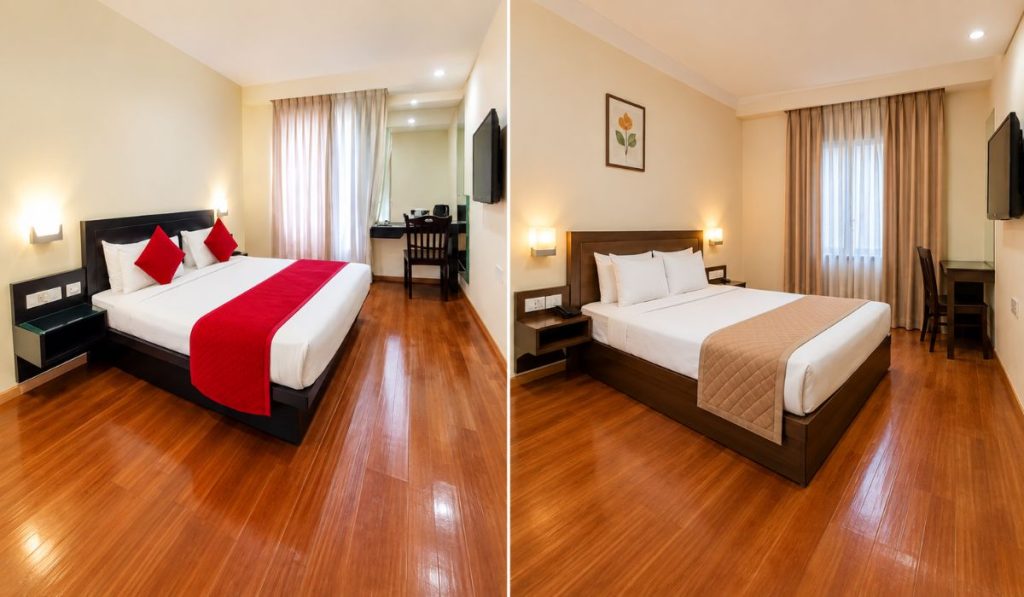
This is the most common comparison travelers make, and understanding the deluxe room meaning becomes much easier when you compare the actual specifications of a standard room and a deluxe room side by side.
| Feature | Standard Room | Deluxe Room |
|---|---|---|
| Position in category | Usually base room | Usually upgraded category |
| Floor area | Often the hotel’s smallest | May be larger |
| Furnishings | Functional, essential | May be upgraded |
| Bed quality | Standard bedding | Often improved bedding |
| Bathroom | En-suite | Often upgraded; may include bathtub |
| View | Internal or street-facing | Often better view or floor level |
| Seating | Limited or none | Usually a seating area |
| Amenities | Essential hotel amenities | May include additional features |
| Price | Lower | Usually higher |
The standard room is the hotel’s base offering. It provides the essential hotel room experience — bed, bathroom, basic amenities — at the lowest available price.
The deluxe room is usually the first meaningful upgrade, offering more comfort, better position or additional facilities. But the actual difference depends entirely on how the individual property defines its categories.
These are common patterns, not universal rules. Some hotels charge a significant premium for their deluxe room; others have a minimal difference. Compare specifications, not names.
Superior Room vs Deluxe Room
A common room hierarchy used by many hotels is:
Standard → Superior → Deluxe → Suite
In this structure, a superior room sits above the standard room but below the deluxe room. The superior category often indicates a slightly better view, a higher floor or marginally more space than the standard room, while the deluxe room takes the next step with more pronounced upgrades in size, furnishings or amenities.
However — and this is a genuinely important point — this hierarchy is not universal. Some hotels skip the superior category entirely. Others position superior above deluxe. A small number use the terms interchangeably.
Never compare “Deluxe” at one hotel with “Superior” at a different hotel based on the name alone. The labels mean different things at different properties. What matters is comparing the actual floor area, bed type, occupancy limit, bathroom configuration, view and amenities at the specific property you are considering.
Deluxe Room vs Suite: What’s the Difference?
The most important distinction between a deluxe room and a suite is layout, not simply quality or price.
| Deluxe Room | Suite | |
|---|---|---|
| Layout | One main room combining sleeping and sitting space | Bedroom with a separate or semi-separated living area |
| Floor area | Larger than standard; varies by property | Generally larger than deluxe |
| Pricing | Mid-tier upgrade | Premium to luxury tier |
| Best for | Couples, solo travelers, short stays | Families, longer stays, those needing workspace and living space |
A suite is not just a very large deluxe room. It is a different room type with a distinct layout — typically a separated bedroom and a living or sitting room. Taj Hotel & Convention Centre Agra, for example, lists its Deluxe Suite at approximately 70 sq m with a separate bedroom and living area, making it structurally different from a deluxe room at the same property.
Note: Junior suites and studio suites sometimes have open-plan layouts that feel similar to a large deluxe room. Always check the floor plan or photos if the room layout matters for your stay.
Deluxe vs Premium vs Luxury Room
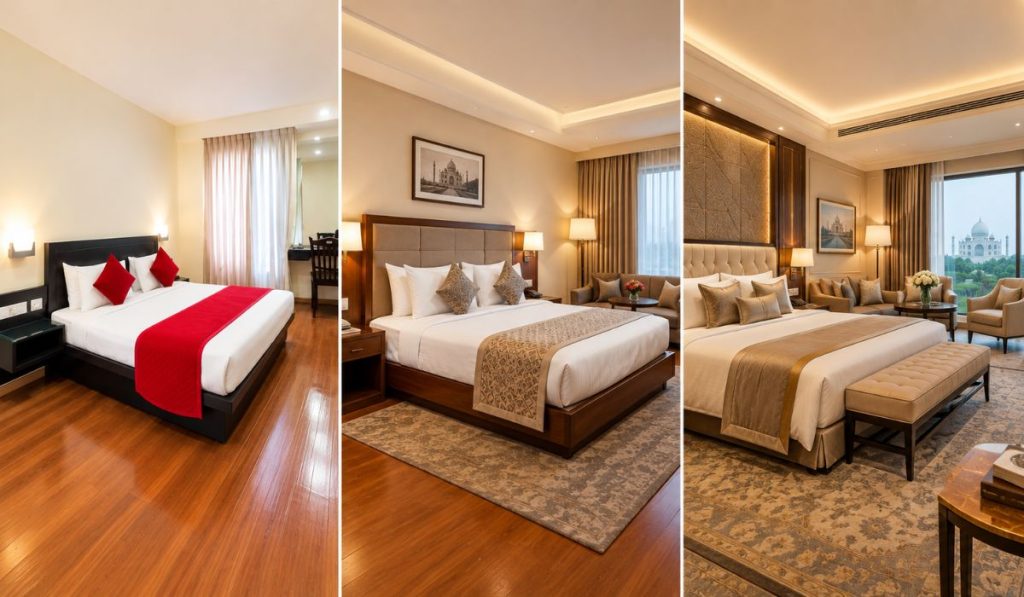
These three terms appear across hotel booking platforms and cause significant confusion because none of them is a standardised global classification.
| Term | Typical Usage |
|---|---|
| Standard | Hotel’s base room category |
| Superior | Minor upgrade, often view or floor |
| Deluxe | Meaningful upgrade in space, furnishings or position |
| Premium | Often highlights a specific selling point: view, floor, wing |
| Luxury | Frequently used as marketing language at upscale properties |
| Suite | Distinct room type with separated living and sleeping areas |
A premium room at one hotel may mean a better view or a higher floor rather than a larger room. A luxury room at another property may simply be that hotel’s branding for what other properties call a deluxe or superior room.
The practical rule: Room names are less important than the actual specifications behind them. Compare dimensions, amenities and photos — not adjectives.
What to Check Before Booking a Deluxe Room
Because the deluxe room meaning depends on how each property defines its room categories, the following checklist will serve you far better than the category name alone:
Standard checklist:
- ☐ Actual room size (m² or sq ft)
- ☐ Bed type (king, queen or twin?)
- ☐ Maximum occupancy
- ☐ Bathroom configuration (bathtub, shower or both?)
- ☐ View (what does the room actually face?)
- ☐ Balcony availability
- ☐ Air conditioning
- ☐ Wi-Fi (speed and whether it is complimentary)
- ☐ Breakfast inclusion
- ☐ Cancellation policy
Less obvious things to verify:
- Are the room photos the actual room or a representative category image?
- Is breakfast included in the rate or charged separately?
- Is the view guaranteed, or is it “subject to availability” on check-in?
- If the hotel mentions a landmark view, does it mean a full, unobstructed view or a partial glimpse?
- Is an extra bed genuinely available, and what does it cost?
- Is the room located near a noisy event hall, elevator bank or service corridor?
- Does the listed room size include the bathroom and wardrobe area?
- Are taxes and service charges included in the displayed rate?
These eight questions are what most booking platforms and hotel websites do not proactively answer — but they matter considerably when choosing between room categories.
Choosing a Deluxe Room for an Agra Stay
Agra is one of India’s most-visited travel destinations, with the Taj Mahal, Agra Fort — a UNESCO World Heritage Site — and Mehtab Bagh among the primary attractions. Room selection in Agra involves a few practical considerations that do not apply to most other destinations.
For Taj Mahal visitors: The Taj Mahal opens approximately 30 minutes before sunrise and closes approximately 30 minutes before sunset (closed Fridays). For sunrise visits — which are among the most popular experiences in Agra — hotel location and check-in/breakfast timing become directly relevant to your itinerary. A hotel situated in Tajganj, close to the Taj Mahal East Gate area, allows easier early-morning access without long transport times. You can check Taj Mahal visiting hours for current timing and gate information.
For couples: Prioritise room ambience, quietness, view quality and bathroom — a bathtub or upgraded bathroom can meaningfully enhance a special-occasion stay.
For families: Focus on maximum occupancy, bed configuration, floor area, bathroom size, extra-bed availability and breakfast inclusion.
And For business travelers: Verify Wi-Fi reliability, desk setup, air conditioning, breakfast timing, laundry availability and transport options.
Hotel Sun Grand is located in Tajganj, within the Taj Mahal East Gate area. Its Deluxe Room includes air conditioning, complimentary breakfast, Wi-Fi and laundry facilities — check the current room page for availability and rates, as pricing is updated regularly.
For broader options, you can also explore hotels in Agra near the Taj Mahal and review 3-star hotel room types for a practical guide to how Deluxe, Super Deluxe and suite categories are typically structured at mid-scale properties. You can also visit Incredible India’s official Taj Mahal page and Agra Fort page for authoritative visitor information.
7 Things Hotels Don’t Always Tell You About Deluxe Rooms
This is where most generic articles stop and where this one continues.
1. “Deluxe” has no universal size. You cannot know what floor area to expect from the word alone. Always read the hotel’s own measurement.
2. A higher category name doesn’t automatically mean a better view. A standard room on an upper floor at some properties has a better view than a deluxe room on a low floor. Check the floor number and view direction specifically.
3. “Taj view” is not standardised either. If a hotel in Agra advertises a “Taj view” room, ask whether it is a full, unobstructed view or a partial sighting between buildings. The difference is significant.
4. A suite is not just a bigger deluxe room. A suite is a different room structure — with a separated living area. Booking a suite because it sounds more luxurious without verifying the layout may not deliver what you expect.
5. Room photos often represent the category, not your exact room. Hotels frequently photograph their best room in a category. The specific room assigned to you may have a different floor, view or configuration within the same category.
6. Breakfast can flip the value equation. A deluxe room with breakfast included at ₹4,500 may offer better overall value than a standard room without breakfast at ₹3,200 when you factor in the cost of dining out. Always compare total cost of stay, not just room rate.
7. Compare specifications, not adjectives. The most important words in a room description are not “luxurious,” “elegant” or “superior.” They are: sq m, bed size, occupancy, bathtub, balcony and view.
Are Deluxe Rooms Worth the Extra Cost?
The honest answer is context-dependent.
A deluxe room is often worth it when:
- You are staying for two or more nights
- The actual listed specifications show a meaningful upgrade
- The price difference is modest (typically under 20–30% premium over standard)
- You value natural light, a better view or an upgraded bathroom
- You are celebrating a special occasion
A deluxe room may not be worth it when:
- You plan to spend most of your time visiting attractions
- The property’s own description shows minimal actual difference between standard and deluxe
- The price premium is significant relative to the benefit
- The view difference is minimal or unverifiable
The clearest signal: compare the hotel’s own listed specifications for standard and deluxe side by side. If the differences are concrete (larger floor area, bathtub, balcony, better floor), the upgrade usually delivers. If the differences are vague (“enhanced comfort,” “superior ambience”), proceed with caution.
FAQs About Deluxe Rooms and It,s Meaning
1: What does deluxe room mean in a hotel?
The deluxe room meaning in a hotel generally refers to a room category positioned above the standard room, typically offering more space, better furnishings, upgraded amenities or a better location.
2: What is the difference between a standard room and a deluxe room?
A standard room is the hotel’s base offering. A deluxe room usually provides a meaningful upgrade — often more floor area, better furnishings, an improved view or additional amenities. The precise difference varies between properties, so always compare the listed specifications.
3: Is a deluxe room bigger than a standard room?
Usually, but not always. Many hotels offer more floor space in the deluxe category, but some hotels differentiate primarily on view, floor level or amenities rather than room size. Check the listed square footage at your specific hotel.
4: What amenities are usually included in a deluxe room?
Common inclusions are: air conditioning, Wi-Fi, a seating area, better bedding, an upgraded bathroom, tea and coffee facilities, TV, an in-room safe and room service. A balcony, minibar or bathtub may be included at some properties. Verify the specific amenities list on the hotel’s own room page.
5: Is a deluxe room better than a superior room?
In most hotels that use both labels, deluxe is positioned above superior. However, this hierarchy is not universal — individual properties may define and position these categories differently. Always check the property’s specific room descriptions rather than assuming a fixed order.
6: What is the difference between a deluxe room and a suite?
The primary difference is layout. A deluxe room is a single room combining the sleeping and sitting areas. A suite generally has a physically separated living area and sleeping area. Suites tend to be significantly larger and more expensive.
7: Is a deluxe room the same as a premium room?
No. Premium and deluxe are separate category labels, and neither is universally defined. Some hotels position premium above deluxe (often based on view or location); others use the labels in the reverse order. Compare the actual room specifications at your chosen property.
8: Which is higher — deluxe or luxury?
In most cases, “luxury” sits above or alongside “deluxe” in a hotel’s category hierarchy, but “luxury” is often a marketing term rather than a defined classification. At upscale properties, every room may be presented as a luxury offering. Compare actual specifications rather than relying on the label.
9: How big is a deluxe hotel room?
There is no universal size. Deluxe rooms range from around 18–20 sq m at budget-to-mid properties to 40–50+ sq m at premium and five-star hotels. Always check the specific property’s listed square footage.
10: Is a deluxe room worth the extra cost?
It depends on how much you plan to use the room, the actual specification difference between categories at that specific hotel, and the price gap. When the listed differences are concrete and the premium is modest, a deluxe upgrade usually delivers value — especially for multi-night stays.
11: What should I check before booking a deluxe room?
Check: room size (m²), bed type, maximum occupancy, bathroom configuration, view, balcony availability, included amenities, breakfast inclusion, cancellation policy and actual room photos. These specifics matter far more than the category name.
12: What is a deluxe room in Agra?
In Agra, as elsewhere, “deluxe room” is defined by individual properties. At hotels in the Tajganj area near the Taj Mahal, a deluxe room often includes air conditioning, Wi-Fi, complimentary breakfast and an upgraded bathroom. Properties closer to the East Gate may also offer rooms with a partial or full Taj Mahal view as part of their deluxe or superior categories.
Final Takeaway – Deluxe Room Meaning
The deluxe room meaning is clear in broad terms: it is a hotel room positioned above the standard category, offering a noticeably upgraded experience in space, furnishings, amenities or location. The important caveat is that “deluxe” is a property-specific label — not a certified industry grade — so what it actually delivers is defined by each hotel individually.
Before booking any deluxe room, read the hotel’s own room description carefully, check the listed floor area, compare the amenities and look at real room photographs. The label tells you the category; the specifications tell you the value.
For travelers planning a stay in Agra, room selection is as much about location — proximity to the Taj Mahal East Gate, breakfast timing for sunrise visits and transport logistics — as it is about in-room features. Explore the rooms at Hotel Sun Grand and the hotel’s range of services in Agra to see how a Tajganj-based property presents its room categories and facilities.


Pingback: 3 Star Hotel Room Types Explained: Deluxe vs Suite